Mental load: when you have to think of everything
The parent-teacher meeting, the vaccination, the present for the kids’ birthday party, the shoes that are slowly getting too small – and you’re thinking about all of it while you’re actually busy with something else.
When your mind keeps planning ahead nonstop, it isn’t simply a matter of getting better organized. This constant thinking ahead has a name: mental load.
What mental load actually is
Mental load is the invisible thinking work behind family life: noticing what’s needed, planning ahead, making decisions, remembering and keeping track of whether something has been done. What others see is often just the doing. The planning, remembering and following up stays invisible.
With a birthday present, it isn’t just the shopping. It’s also the questions: When is the party? What would suit the child? When do we have to reply by? And who remembers to send the present along in time?
Often a large part of this responsibility stays with one person. Often it has simply settled that way over time. That doesn’t automatically make the split fair – and it doesn’t have to stay that way. So relief doesn’t just mean handing off individual tasks, but also sharing the responsibility for them.
Mothers often take on a large part of this thinking work. But any parent can end up overloaded.
A little less on your mind for a moment
- Out of your head, onto paper. For two minutes, write down everything that’s circling in your head – in no particular order, without sorting. That way it’s all in one place for now. You don’t have to sort the list or work through it right now.
- Cross off or postpone one thing. Pick a task that doesn’t have to happen this week and deliberately cross it off. That isn’t failure, it’s a decision.
So it doesn’t all stay with you
If you share the responsibility, pick one concrete everyday situation: Who notices that something is coming up? Who plans? Who does it? And who has to follow up?
You don’t have to present a complete list first for your load to be taken seriously.
One option is to hand over a whole area – including the planning and the follow-up. For example: “Could you take over the kids’ birthday party invitations completely from now on – from putting the date in the calendar to the present and the RSVP?”
If you carry the responsibility alone or nobody can reliably take over right now, handing things off may not be an option straight away. Then it’s first about what can be dropped, made simpler or covered with support from outside.
How FlowParent can support you
In FlowParent, you can select “Mental load” as what’s draining your energy right now and say how much time you have. You get short suggestions that fit what you’ve entered.
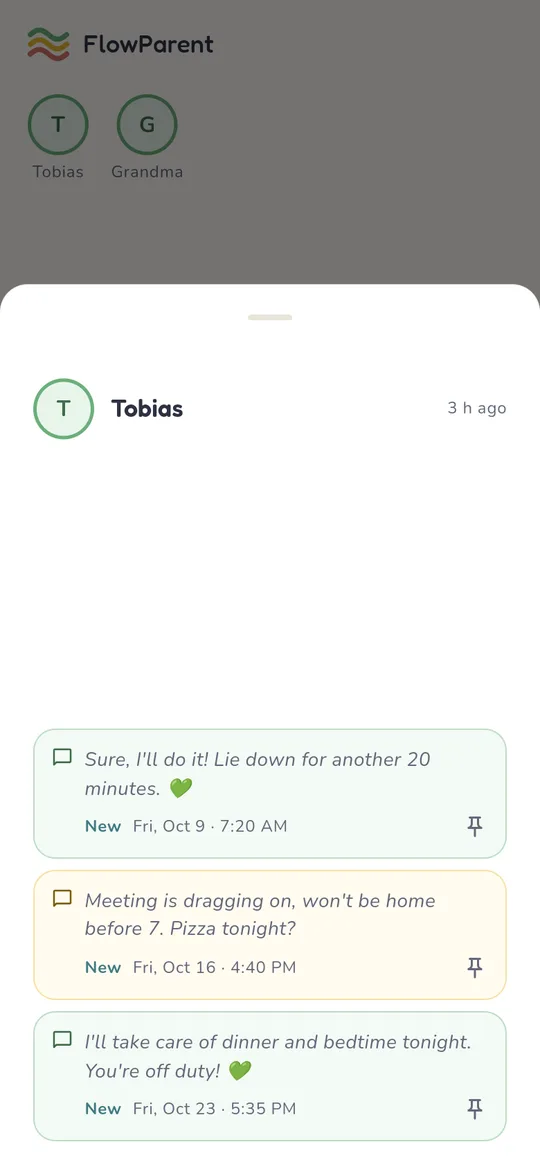
If you like, you share your traffic-light color with your family. A yellow signal can start a conversation without you having to explain everything right away.
Looking back, you can see how often you logged mental load as a strain and how you were doing during that time. That can be a reason to look together at what would ease the load.
FlowParent can help make your load visible. The app is no substitute for a fair division of tasks.
Would you rather check how full your battery is first? Take the energy check
FlowParent is no substitute for counseling or therapy. If the load has been weighing you down for a long time, please get support, for example from a family or couples counseling service near you.